A-Chamber
Animal Cage Enclosures
- Adjustable ventilation
- Rugged construction
- Easily cleaned and decontaminated
- Optimized for gas efficiency
- Three standard sizes
- Fast recovery time
- Hypoxia or Hyperoxia in vivo models
MULTIPLE EFFICIENCIES
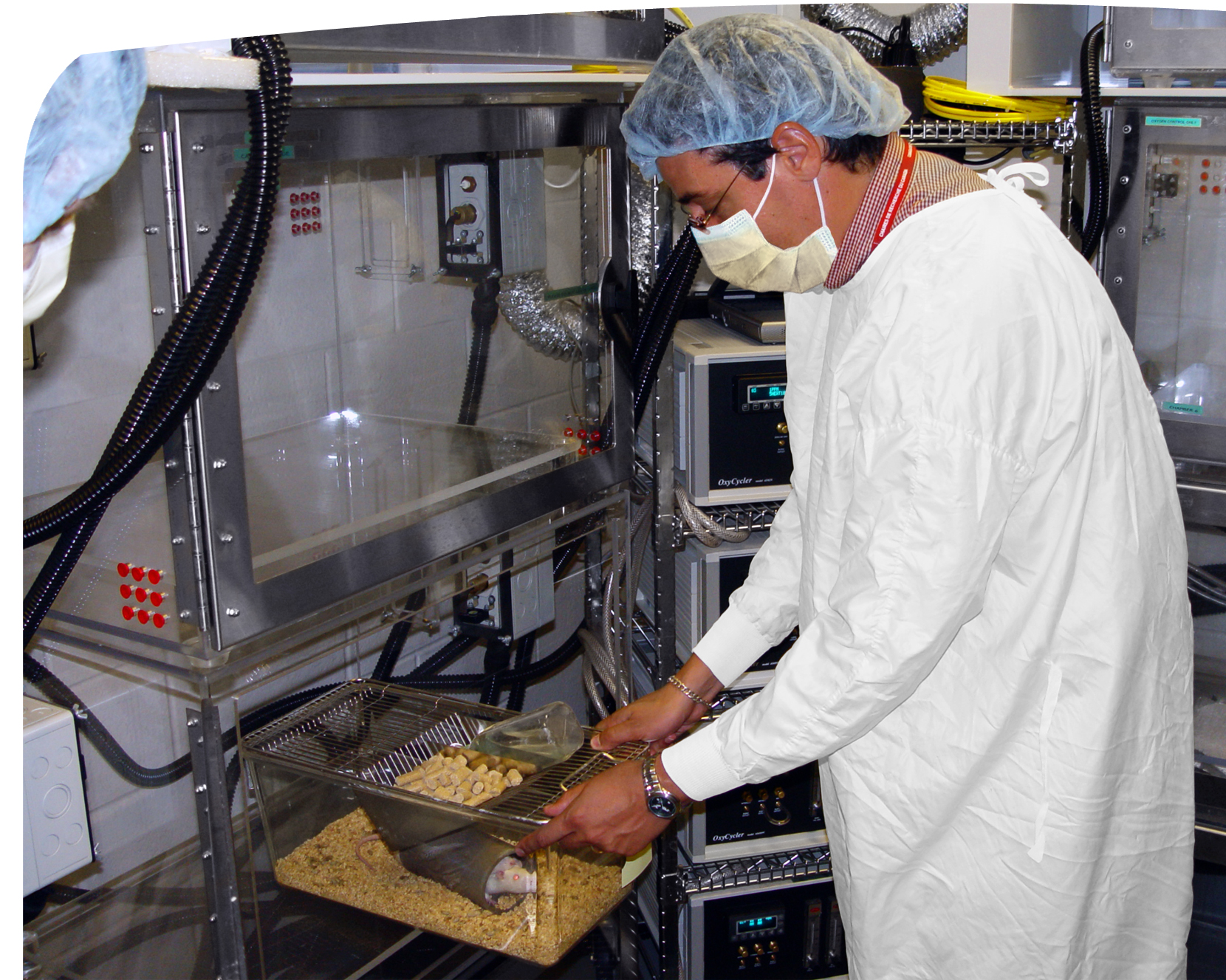
The A-Chamber works with a large range of BioSpherix Ltd. gas controllers. These controllers continuously monitor atmospheric condition, ensuring humane conditions as well as experimental integrity.
The A-Chamber’s atmosphere can easily be controlled by any of our gas controllers including the ProOx (Oxygen Controller), ProCO2 (Carbon Dioxide Controller), or OxyCycler Series (for all bioactive gases, e.g. Oxygen, Carbon Dioxide, Carbon Monoxide, Nitric Oxide, etc.).
RUGGED CONSTRUCTION
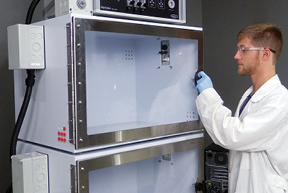
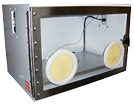
The lab chamber for animal cage washers is fabricated from either durable clear acrylic or white polypropylene with an acrylic door, to allow easy viewing of the chamber interior. Mounting cutouts on the sides of the chambers provide space for BioSpherix controller adapters and pods, or custom adapters for specialized needs.
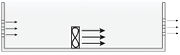
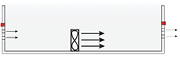
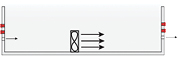
Ventilation rate is controlled passively with the lab chamber for animal cage washers. A fan keeps air flowing, and holes drilled into the sides of the chambers allow stale air to be displaced. You control the amount of ventilation by controlling which ventilation ports are open or closed in the animal chamber.
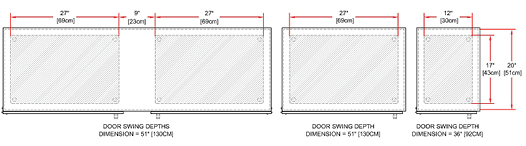
Front Views
(With Riser Plate Dimensions)
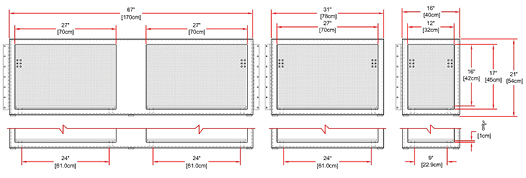
Top Down Views
(With Riser Plate Dimensions)
|
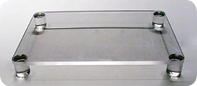
Included with the chamber is a removable riser platform with a 1.5” space underneath. Cages will sit on top of this riser and optional humidity or scrubber trays can be placed underneath the riser. Riser platform height is flush with opening of the chamber. This ensures cages being moved in and out will not bump the edge of the chamber causing undue stress on the animals. |
A-Chambers are stocked in the following sizes:
|
Custom and specialty chambers are also available. Ask us about our glove and iris port options!
|
Single LatchSingle, quarter-turn latch allows technician to easily open and close the chamber door with one hand. This latch is all that is needed to close the A-Chamber’s heavy stainless steel frame door snugly. No time wasted dealing with many latches that require technicians to set down animal cages to work. Installing Adapter Pods
Installing Adapter Plates
|
How It WorksThe A-Chamber is designed specifically for animals inside cages. This way, you wash smaller cages that fit within various washing machines, automating or otherwise shortening the process. Standard sized A-Chambers fit standard rodent cages with space allocated for water bottles, feeding containers and filter covers. Additionally, they are placed on a riser plate that allows space beneath the cages for desiccants, etc, if your experiment requires them. Custom chambers are available to fit special apparatus. We can accommodate any cage size. Shown above are a few of many options to suit your lab’s needs: glove fronts (left), iris ports and heating pad (right) Monitor PodsSome oxygen controllers come equipped with monitor pods, which keep tabs on PPM CO2, temperature and humidity over the time of the exposure. These controllers work alongside other controllers, meeting your labs need whatever they may be. Atmosphere Control Options OverviewThe A-Chamber is functionalized by BioSpherix gas controllers. The following chart provides basic information about standard control options. Controllers work together, and the modularity of controls allows you to buy exactly what you need and nothing more.
|
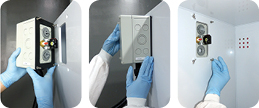
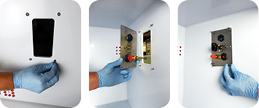 Each chamber has two standard cut outs. All controllers attach snugly via pod or plate. If more than two adapter plates or pods are necessary, more can be added with minor modification.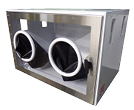
Ventilation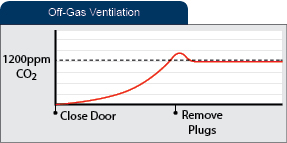 Chambers are specifically designed to use ventilation for handling off-gases instead of scrubbers. This method is far superior to exclusive dependence upon scrubbers (soda lime for CO2, desiccants for humidity and activated carbon for VOCs) because ventilation can never be depleted like scrubbers. Animal chambers that depend only on scrubbers are reliant on the technician to attend to and frequently change the scrubbers, making them less reliable, less convenient and more expensive. In most cases, if the ppm CO2 exhaled by the animals is controlled and limited all other off-gases will be handled successfully as well. One exception may be relative humidity when there is an excessive source of humidity such as overly moist litter (caused from animal urination, water bottles dripping, etc). When the animal exposure requires activity, the amount of moist air exhaled by the animals will also be increased. When applicable, precisely adjust the ventilation of the chamber by using the sensors in a monitor pod. Once the monitor pod has been used to adjust the ventilation, it can be used for documentation in animal safety reviews to verify all worrisome off gases were successfully handled. Furthermore, the monitor pod can be easily moved from chamber to chamber when there is a new need to characterize a chamber. A chamber needs to be characterized before an experiment is performed if there is any change in the chamber. This could include a change in the amount of animals, if there is a new type of animal exposure such as inactive animal vs. active animal exposure (more humidity), etc. The need to characterize the off-gas in each individual chamber is the reason why the monitor pod has its unique mobile design. Once characterization is done, the technician should document the ventilation pattern, by doing this the characterized if the same exposure is repeated. After all exposures have been successfully characterized and documented, and as they are used routinely, the monitor pod should be circulated amongst the chambers for creating a data-logged confirmation record of the off gases that can be shown to the Institutional Review Board (IRB) to demonstrate Good Laboratory Practices (GLP). Chambers are specifically designed to use ventilation for handling off-gases instead of scrubbers. This method is far superior to exclusive dependence upon scrubbers (soda lime for CO2, desiccants for humidity and activated carbon for VOCs) because ventilation can never be depleted like scrubbers. Animal chambers that depend only on scrubbers are reliant on the technician to attend to and frequently change the scrubbers, making them less reliable, less convenient and more expensive. In most cases, if the ppm CO2 exhaled by the animals is controlled and limited all other off-gases will be handled successfully as well. One exception may be relative humidity when there is an excessive source of humidity such as overly moist litter (caused from animal urination, water bottles dripping, etc). When the animal exposure requires activity, the amount of moist air exhaled by the animals will also be increased. When applicable, precisely adjust the ventilation of the chamber by using the sensors in a monitor pod. Once the monitor pod has been used to adjust the ventilation, it can be used for documentation in animal safety reviews to verify all worrisome off gases were successfully handled. Furthermore, the monitor pod can be easily moved from chamber to chamber when there is a new need to characterize a chamber. A chamber needs to be characterized before an experiment is performed if there is any change in the chamber. This could include a change in the amount of animals, if there is a new type of animal exposure such as inactive animal vs. active animal exposure (more humidity), etc. The need to characterize the off-gas in each individual chamber is the reason why the monitor pod has its unique mobile design. Once characterization is done, the technician should document the ventilation pattern, by doing this the characterized if the same exposure is repeated. After all exposures have been successfully characterized and documented, and as they are used routinely, the monitor pod should be circulated amongst the chambers for creating a data-logged confirmation record of the off gases that can be shown to the Institutional Review Board (IRB) to demonstrate Good Laboratory Practices (GLP). |
Ventilation Adjustment
Full ventilation by removing all plugs shows 81° of ventilation.
Reduce the ventilation by adding a set of plugs. This reduces gas consumption to make your process more efficient.
Halve ventilation by adding an additional set of plugs. Using the monitor pod will help to characterize the chambers.
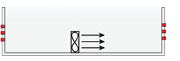
This drawing shows all ventilation has been plugged and no active force is causing ventilation.
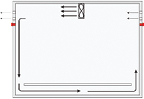
The above drawing illustrates how air flows around the chamber and beneath the riser plate. |
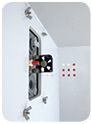
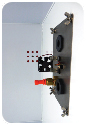 Both adapter pods and plates (that accommodate all BioSpherix animal series controllers) attach to standard-sized cutouts via bolt and wingnuts. The fans on the plates push air inside the chamber at an array of 3×3 ventilation holes in the back, forcing circulation and gas homogenization while displacing off gases, ensuring good quality air conditions for animals.