
Cells Need Protocol
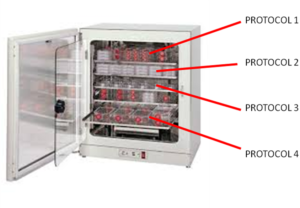 There are many ways to use an incubator to grow cells. Many laboratories use the same incubator for many different protocols at the same time. In a perfect lab, the cells in each protocol would stay in their own incubator and nobody else would open the door after they go in. Due to logistics, though, most laboratory incubators look more like the one above. Learn more about the advantages of cell protocols in lab research below.
Whose turn was it to check the water pan this week?
It is impossible to provide unbroken, optimized conditions for your cells in a shared incubator. The more an incubator is shared, the more your cells are at risk.
However, using subchambers, the same standard CO2-controlled incubator can be divided into separate spaces for separate protocols.
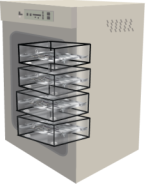 This has a number of important advantages:
1. Individual conditions can be established within each subchamber, including controlled oxygen conditions.
2. Multiple conditions can be housed in the same incubator, expanding parallel testing capacity.
3. Each subchamber is accessed only when necessary for that protocol, protecting the cells’ environment when the incubator is opened for work on other protocols.
4. Humidity can be individually controlled.
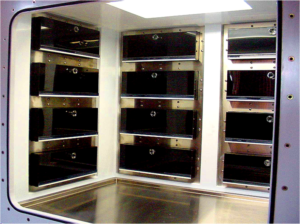 This reduces risks that come with shared incubators, particularly the risks with opening the incubator into room air. We will have more on the effect of room-air conditions on cells in future posts.
The ideal solution to providing unbroken environmental controls for cells, is to take that subdivided incubator and have it open not into a room at all, but right into a workspace where conditions can be matched to the individual incubator.
Here, the workspace and the incubator function together to provide unbroken conditions for the cells in each protocol. Even in a shared lab, the cells are protected.
Cytocentric incubation means that the equipment can be adjusted for the needs of the cells as dictated by individual protocol, not the other way around.
Recent Articles

Cytocentric Visionaries: Dr. David Gozal, MD – Part Two
Cytocentric Visionaries: Dr. David Gozal, MD Part 2: COVID-19 Research, Prone Positioning, and Chronoadequacy Alicia Henn, PhD MBA, Chief Scientific Officer, BioSpherix David Gozal, MD, MBA, PhD (Hon) is the Marie M. and Harry L. Smith Endowed Chair and Chairperson of...

Cytocentric Visionaries: Dr. David Gozal, MD – Part One
Cytocentric Visionaries: Dr. David Gozal, MD Part 1: COVID-19, ACE2, and the Circadian Clock Alicia Henn, PhD MBA, Chief Scientific Officer, BioSpherix David Gozal, MD, MBA, PhD (Hon) is the Marie M. and Harry L. Smith Endowed Chair and Chairperson of the Department...

Cytocentric Visionaries: David Lawrence
Cytocentric Visionaries: Dr. David Lawrence, University at Albany Inflammation and Oxidative Stress: Cell Conditions Matter, Even for CAR-T Dr. David A Lawrence is Professor and Chair of Environmental Health Sciences, at the School of Public...
About The Author

Alicia D Henn, PhD, MBA
Chief Scientific Officer of BioSpherix, Ltd
Alicia Henn has been the Chief Scientific Officer of BioSpherix, Ltd since 2013. Previously, she was a researcher at the Center for Biodefense Immune Modeling in Rochester, NY. Alicia obtained her PhD in molecular pharmacology and cancer therapeutics from Roswell Park Cancer Institute in Buffalo, NY and her MBA from the Simon School at University of Rochester in Rochester, NY.
If you would like to be featured in our Cytocentric Visionary Series, contact us. We would love to hear about your work.